
Quick Answer: USPS approved locking mailboxes must feature mail slots at least 1.75 inches high by 10 inches wide with inward-facing flaps, while complete mail theft prevention requires layering locking mailboxes with security cameras, package lockboxes, and USPS Informed Delivery monitoring to protect against the 52,000+ annual high-volume mail theft attacks targeting checks, tax documents, and personal information.
Table of Contents
- Mail Theft Has Become a National Crisis
- Key Takeaways
- What Mail Thieves Are After
- USPS Approved Locking Mailboxes: Regulations and Requirements
- Mailbox Security Cameras: Your 24/7 Mail Guard
- Package Delivery Solutions: Beyond the Mailbox
- USPS Informed Delivery: Free Mail Monitoring
- Mail Hold Services and Strategic Pickup Timing
- Cluster Mailbox Security: Protecting Community Mail
- What to Do When Mail Is Stolen: Step-by-Step Response
- Cost Breakdown: Building Layered Mail Security
- Protecting Your Mail
- Frequently Asked Questions
- Sources
Mail Theft Has Become a National Crisis
Mail theft isn’t just annoying – it’s exploded into a full-blown identity theft pipeline. In fiscal year 2024, USPS recorded over 52,000 high-volume mail theft attacks, a staggering 156% increase since 2019 and 2,238% since 2010. We’re talking about organized criminals targeting blue collection boxes, neighborhood cluster mailboxes, and yes – your curbside mailbox – all to steal checks, credit cards, and documents loaded with your personal information.
The financial damage is massive. Between February and August 2023 alone, Americans lost more than $688 million to mail theft-related check fraud. Financial institutions filed 682,000 Suspicious Activity Reports related to check fraud in 2024 – a 139% jump from 2020. Mail thieves now account for $815 million in annual losses, and they’re getting bolder.
Key Takeaways
- USPS approved locking mailboxes require mail slots measuring at least 1.75 inches high by 10 inches wide with inward-facing protective flaps, must accommodate normal daily mail volume without requiring carriers to use keys, and need postmaster approval before installation.
- Over 52,000 high-volume mail theft attacks occurred in fiscal 2024, with criminals specifically targeting checks, tax documents, credit cards, and personal information to fuel identity theft and check washing scams worth $815 million annually.
- Layered prevention combining locking mailboxes ($50-$200), video doorbells ($100-$250), USPS Informed Delivery (free), and strategic mail holds reduces mail theft risk by 80-90% compared to standard unsecured mailboxes.
- Mail theft is a federal felony under 18 U.S.C. § 1708 carrying penalties up to five years in federal prison and $250,000 in fines, with USPS Postal Inspectors making 4,754 arrests in 2024 for mail-related crimes.
- Browse Batten’s video doorbell collection for subscription-free surveillance options that monitor your mailbox 24/7 with instant mobile alerts when mail arrives or suspicious activity occurs.
What Mail Thieves Are After
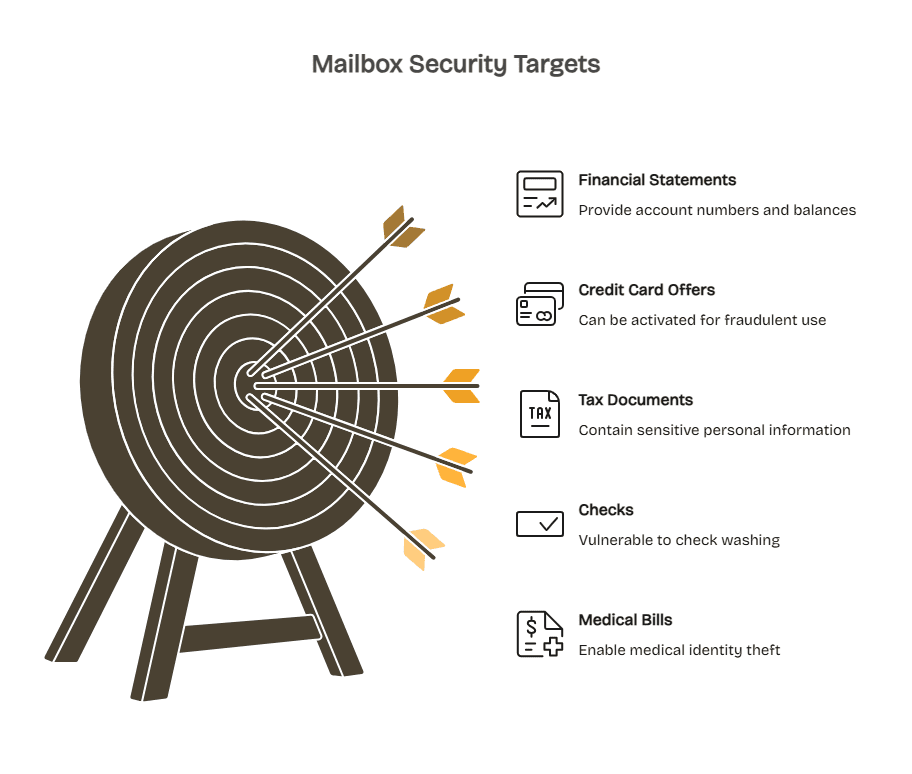
Mail thieves aren’t randomly grabbing envelopes hoping for birthday cash. They’re running sophisticated operations targeting specific high-value items that enable larger financial crimes.
Primary Targets in Your Mailbox
- Checks: The number one target. Thieves use “check washing” – household chemicals that remove ink – to alter payee names and amounts. That $150 check to your lawn service becomes a $15,000 check to a criminal’s account. Suspicious Activity Reports for check fraud nearly doubled from 2021 to 2023.
- Tax Documents: W-2s, 1099s, and IRS correspondence contain Social Security numbers, income data, and enough information to file fraudulent tax returns in your name. Identity thieves file fake returns before you do, pocketing your refund while you’re left fighting the IRS.
- Credit Card Offers: Pre-approved credit applications can be activated and used before you even know they existed. Though issuers have tightened activation requirements, determined thieves still exploit these.
- Financial Statements: Bank and investment statements provide account numbers, balances, and spending patterns – everything needed for account takeovers.
- Medical Bills: Health insurance information enables medical identity theft, where criminals use your coverage for procedures, prescriptions, and services that end up on your credit report.
The Identity Theft Connection
Mail theft serves as the entry point for cascading identity crimes. According to the FBI and USPS Postal Inspection Service, stolen mail enables account takeovers, new account fraud, government benefits fraud, and medical identity theft. The Federal Reserve’s 2024 survey revealed check fraud now accounts for 30% of all fraud losses, second only to debit card fraud.
USPS Approved Locking Mailboxes: Regulations and Requirements
Not every locking mailbox qualifies for USPS approval. The regulations exist to balance security for you with accessibility for carriers who deliver to millions of addresses daily.
Core USPS Approval Requirements
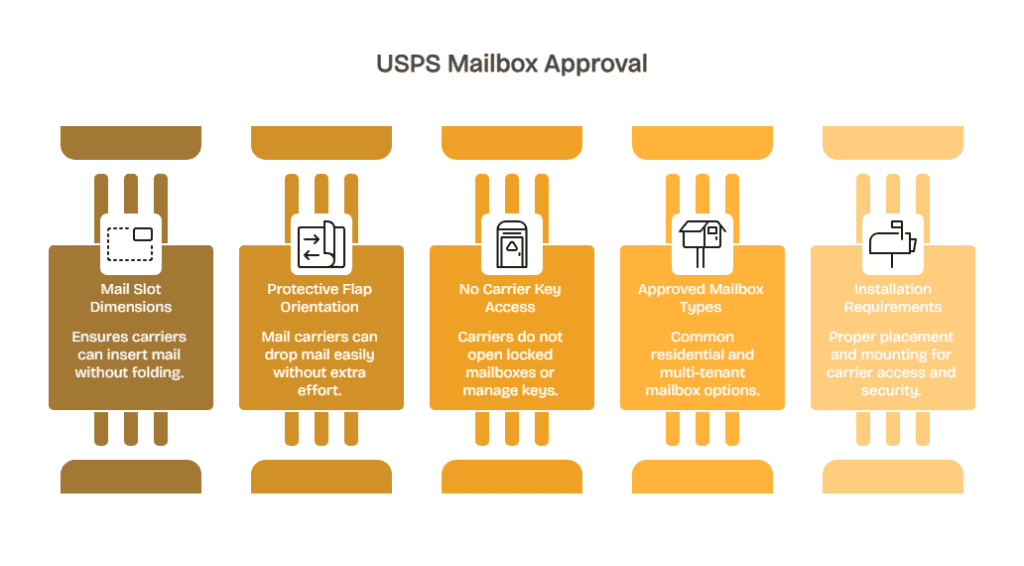
Mail Slot Dimensions: The incoming mail slot must measure at least 1.75 inches high by 10 inches wide. This ensures carriers can insert standard envelopes, catalogs, and Priority Mail flat rate envelopes without folding them.
Protective Flap Orientation: Locking mailboxes must have protective flaps oriented inward so mail carriers can drop mail through the slot without extra effort. Outward-facing flaps that require pushing through are prohibited.
No Carrier Key Access: USPS carriers do not open locked mailboxes and will not accept or manage mailbox keys. Your locking mechanism must allow one-way mail insertion only.
Approved Locking Mailbox Types
Post-Mounted Locking Mailboxes: The most common residential option. These mount on posts at curbside locations where carriers deliver from vehicles. Mail Boss, Architectural Mailboxes, and Whitehall offer USPS-approved models ranging from $80 to $200.
Column Mailboxes: Also called package mailboxes, these larger units handle small packages alongside standard mail. The locking mechanism secures both regular mail and larger items.
Cluster Box Units (CBUs): Multi-tenant mailboxes serving neighborhoods and apartments. Each resident has an individual locked compartment.
Installation Requirements for Locking Mailboxes
Curbside Placement: Mount curbside mailboxes on the right-hand side of the road, facing outward for carrier vehicle access. The mailbox bottom should sit 41-45 inches from ground level, with the front edge 6-8 inches back from the curb.
Secure Mounting: Locking mailboxes need sturdy installation. A wobbly post or loose wall mount defeats the purpose – thieves will just rip the entire box off its mounts. Use concrete footings for post installations and heavy-duty anchors for wall mounts.
Address Numbers: Display your house or building number in numbers at least 1 inch tall. Carriers need to identify your box quickly, especially during night deliveries or in poor weather.
Clear Access: Keep vegetation, snow, and obstructions away from your mailbox. Carriers must safely access the slot without leaving their vehicle (for curbside) or walking through hazards.
Mailbox Security Cameras: Your 24/7 Mail Guard
Locking mailboxes stop opportunistic theft, but security cameras catch the pros. Strategic camera placement turns your mailbox into a monitored security zone that deters thieves and provides evidence when needed.
Optimal Camera Placement for Mailbox Monitoring
Position cameras 8-12 feet away from your mailbox at a 30-45 degree downward angle. This captures faces, license plates, and hand movements without creating blind spots. Mount cameras 9-10 feet high to prevent tampering while maintaining clear facial capture.
Camera Features for Effective Mail Monitoring
- High Resolution: 1080p minimum, preferably 2K or higher for reading license plates at 20-30 feet.
- Color Night Vision: Infrared captures faces in darkness, but color night vision with integrated spotlights provides better identification.
- Motion Detection Zones: Configure detection zones specifically around your mailbox to reduce false alerts.
- Local and Cloud Storage: Dual storage protects footage if criminals destroy the camera or cut power.
Video Doorbell Solutions for Mailbox Security
Video doorbells aren’t just for your front door. Positioned correctly, they monitor both entry points and nearby mailboxes, creating dual-purpose security coverage. Learn more about how video doorbells enhance home security.
Google Nest Doorbell
The Google Nest Doorbell delivers 960p HDR video with 145-degree field of view, covering mailboxes within 15-20 feet of entry points. Built-in person, package, animal, and vehicle detection filters alerts to actual security events.
Key Features:
- Battery or wired options for flexible installation
- 3:4 aspect ratio captures faces and ground-level packages
- Night vision with infrared LEDs
- Works with Google Assistant and Amazon Alexa
Nest Aware subscription required for cloud storage ($6-$12/month), but basic functionality works without fees. Available on Batten Shop.

Eufy Security Video Doorbell S330
The Eufy S330 features dual cameras – one facing forward, one angled downward – eliminating the package blind spot. The 2K primary camera captures fine detail while the secondary camera monitors ground-level activity.
Key Features:
- Dual camera system with 2K resolution
- 8GB internal storage plus microSD slot – zero subscription required
- AI detection for people, packages, pets
- Delivery Guard automatically records package deliveries
- Two-way audio for real-time communication
No subscription needed for full features, making this exceptional for monitoring both front doors and nearby mailbox locations. Shop at Batten.

Wyze Video Doorbell v2
Budget-friendly without sacrificing capability, the Wyze v2 delivers 2K HD video at a fraction of premium doorbell costs.
Key Features:
- 2K HD resolution for sharp detail
- Package detection with instant alerts
- Wireless chime included
- microSD slot for local recording
- Quick response pre-recorded messages
Optional $2/month subscription adds person detection and cloud recording, but core functionality works free with local storage. Available through Batten Shop.

Package Delivery Solutions: Beyond the Mailbox
Locking mailboxes secure standard mail, but packages sitting on porches become easy targets. Package theft statistics show 1 in 4 Americans experienced theft in 2024.
Package Lockboxes and Delivery Instructions
Dedicated lockboxes for packages sit on your porch or near your entry. Carriers place deliveries inside, where they remain locked until you retrieve them. Models range from $150-$400 depending on size.
Delivery Instructions: “Leave packages behind planter on left side of porch” gives carriers clear instructions while hiding deliveries from street view. For high-value items, requiring signature confirmation forces personal delivery.
USPS Informed Delivery: Free Mail Monitoring
USPS Informed Delivery provides digital previews of incoming mail before it arrives – essentially a morning report showing what’s coming to your mailbox. This free service now serves over 70 million Americans.
How USPS Informed Delivery Works
Every piece of letter-sized mail runs through USPS automated sorting equipment that scans the exterior. These grayscale images are compiled into your Daily Digest email, typically delivered by 9 AM local time.
What’s Included:
- Mail preview images (grayscale scans)
- Package tracking with real-time updates
- Delivery notifications
- 7-day archive of past images
- New mobile app launched October 2025
Benefits for Mail Theft Prevention
See if expected mail (checks, cards, documents) actually arrives. Missing items flag potential theft immediately. Images provide timestamp records – valuable evidence when filing theft reports or fraud disputes.
Sign up even if you don’t plan to use it actively. Criminals can register your address if you haven’t, potentially intercepting your mail previews.
Mail Hold Services and Strategic Pickup Timing
The most secure mail is mail that never sits in your mailbox unattended. USPS mail holds eliminate exposure windows.
Request USPS to hold all mail at your local post office for 3-30 days while you travel. Submit online at usps.com/holdmail, call 1-800-ASK-USPS, or visit your local post office. Requests need at least 3 days advance notice.
Know your carrier’s typical delivery time (usually 10 AM – 5 PM) and retrieve mail within 1-2 hours when possible. Daily checks signal occupancy even if you don’t expect mail.
Cluster Mailbox Security: Protecting Community Mail
Cluster box units serving multiple households create concentrated theft targets. The Government Accountability Office reported 707 robbery, burglary, and assault crimes off USPS property in 2023.
Cluster Mailbox Protection Strategies
Community Surveillance: Residents sharing CBUs should coordinate security camera coverage. Multiple cameras from different angles create comprehensive monitoring.
Lighting: CBUs in poorly lit areas become nighttime theft opportunities. Motion-activated lights add extra deterrence.
Regular Collection: Retrieve mail promptly after delivery rather than leaving it overnight. Full compartments signal residents aren’t monitoring their mail.
Report Damage: Forced or damaged CBU panels indicate attempted or successful theft. Report damage to USPS immediately.
What to Do When Mail Is Stolen: Step-by-Step Response
Discovering stolen mail requires immediate action across multiple fronts. Similar to protecting your home from squatters, quick response prevents further damage.
Immediate Actions (First 24 Hours)
Document what’s missing with specific items (checks, credit cards, tax forms) and dates. Photograph your mailbox showing damage or tampering. Alert senders to stop payments on checks and cancel cards.
Reporting to USPS Postal Inspectors
Mail theft falls under federal jurisdiction. In 2024, Postal Inspectors made 4,754 arrests and secured 4,228 convictions for mail-related crimes.
How to Report:
- Online: Visit uspis.gov/report
- Phone: Call 1-877-876-2455
- In-person: Visit your local post office
Provide your contact information, specific description of stolen mail, date range, and any surveillance footage.
Credit Monitoring After Mail Theft
Place fraud alerts with credit bureaus. Consider credit freezes that block all access to your credit report. Request free credit reports at AnnualCreditReport.com to check for fraudulent activity.
Cost Breakdown: Building Layered Mail Security
Effective mail theft prevention doesn’t require breaking the bank. Strategic spending on layered security delivers substantial protection at reasonable cost.
| Security Layer | Cost Range | Annual Cost | Protection Level | ROI |
| USPS Approved Locking Mailbox | $50-$200 | $0 after install | High | Excellent |
| Video Doorbell (with mailbox view) | $100-$250 | $0-$144/year | Very High | Excellent |
| Package Lockbox | $150-$400 | $0 after install | High | Very Good |
| USPS Informed Delivery | Free | $0 | Medium | Outstanding |
| Mail Hold Services (as needed) | Free | $0 | Very High | Outstanding |
| Total Investment | $300-$850 | $0-$144/year | Comprehensive | Outstanding |
Protecting Your Mail
Mail theft is rising, but the right protection makes a real difference. Start with a USPS-approved locking mailbox, then layer cameras, package security, and Informed Delivery for stronger defense. Small upgrades today can prevent costly identity theft, fraud, and stress tomorrow – keeping your mail, and your information, secure year-round.
Browse Batten’s security products to keep your mail and home safe from criminals.
Frequently Asked Questions
How Do I Know If My Mailbox Meets USPS Approval Standards?
Check the mail slot dimensions (minimum 1.75″ x 10″) and verify inward-facing flaps. Most manufacturers label boxes as “USPS Approved,” but confirmation with your local postmaster before installation prevents delivery refusal. Bring photos or specifications to your post office for pre-approval.
Can Thieves Still Access Locking Mailboxes With Professional Lock Picks?
High-security locking mailboxes use pick-resistant locks with hardened steel components that resist both picking and forced entry. While no lock is completely pick-proof, quality mailbox locks require specialized tools and time – deterring casual thieves who prefer quick, easy targets. Pair locking mailboxes with cameras to catch anyone attempting prolonged tampering.
What Happens If USPS Carriers Can’t Deliver to My Locking Mailbox?
Carriers place items too large for the mail slot (packages, thick catalogs) either in a designated parcel locker, at your door with a notice, or hold them at the post office for pickup. Ensure your locking mailbox slot accommodates standard Priority Mail envelopes – if your typical mail won’t fit, carriers can refuse delivery entirely.
Does USPS Informed Delivery Work for All Types of Mail and Packages?
Informed Delivery shows letter-sized mail processed through automated equipment (most first-class mail) and provides tracking for all USPS packages with tracking numbers. Hand-sorted mail, items outside automation specs, and mail from private carriers (UPS, FedEx) won’t appear in previews, though USPS packages are comprehensively tracked.
How Quickly Should I Report Suspected Mail Theft to Postal Inspectors?
Report immediately – within 24 hours of discovery. Quick reporting enables Postal Inspectors to check surveillance footage (if available) while it’s fresh and identify patterns if multiple neighbors experienced theft. Early reports also establish timeline documentation crucial for financial fraud disputes and insurance claims.
Are Cluster Box Master Keys the Same Across All Neighborhoods?
No. USPS uses specific arrow key series assigned to different geographic areas, though not every CBU requires a unique key. This system means stolen keys can compromise multiple cluster boxes across neighborhoods. That’s why carrier robberies targeting arrow keys trigger widespread mail security alerts and postmaster notifications.
Can I Install Security Cameras Pointing at Neighborhood Cluster Mailboxes?
Yes, as long as you’re not recording areas where people have reasonable expectations of privacy (inside buildings, private yards). Public street views and shared mailbox areas are legal to monitor. Coordinate with neighbors to avoid camera overlap conflicts and to create comprehensive coverage from multiple angles.
What If My Landlord Refuses to Upgrade to Locking Mailboxes?
Request upgrades in writing, citing increased mail theft rates and tenant safety. If refused, install supplementary security – use package lockboxes for deliveries, set up Informed Delivery, and hold mail at post offices when traveling. Document all theft incidents with police reports – repeated problems may constitute habitability issues under local tenant laws.
How Do Mail Thieves Wash Checks Without Detection?
Check washing uses common household chemicals (acetone, bleach, or commercial check-washing solutions) to dissolve water-based inks while leaving magnetic ink readable. Thieves alter payee names and amounts, then deposit checks using fake IDs or money mule accounts. Banks often can’t detect washing immediately because magnetic ink passes automated readers.
Is There a Difference Between Federal and State Prosecution for Mail Theft?
Federal prosecution (18 U.S.C. § 1708) carries five years maximum prison and $250,000 fines, while state charges typically classify mail theft as misdemeanors with shorter jail terms unless high-value items push it to felony territory. Federal authorities prosecute USPS mail theft; state prosecutors handle private carrier (UPS, FedEx) theft. Federal sentences are harsher and don’t offer early release programs available in state systems.
Sources
- How the U.S. Mail Became a Data Breach. 2025. FEDweek – Federal Manager’s Daily Report. https://www.fedweek.com/federal-managers-daily-report/how-the-u-s-mail-became-a-data-breach/
- FinCEN Issues In-Depth Analysis of Check Fraud Related to Mail Theft. 2024. Financial Crimes Enforcement Network (U.S. Department of the Treasury). https://www.fincen.gov/news/news-releases/fincen-issues-depth-analysis-check-fraud-related-mail-theft
- Check Fraud Accounts for 30% of Fraud Losses, According to Fed Survey. 2024. OrboGraph. https://orbograph.com/check-fraud-accounts-for-30-of-fraud-losses-according-to-fed-survey/
- Package Theft Statistics. 2025. Capital One Shopping Research. https://capitaloneshopping.com/research/package-theft-statistics/
- Inspection Service Arrests. 2024. United States Postal Service – Postal Facts. https://facts.usps.com/5500-arrests/
- Why Mail Theft Is on the Rise. 2024. TIME. https://time.com/6999321/mail-theft-rising/
- Mail Theft-Related Check Fraud Is on the Rise. 2025. FBI Internet Crime Complaint Center (IC3) / United States Postal Inspection Service. https://www.ic3.gov/PSA/2025/PSA250127