
Quick Answer: X-Sense is generally the better choice for renters and homeowners who want affordable, battery-powered alarms with wireless interconnection and 10-year maintenance-free batteries, while Kidde is the stronger option for hardwired systems, voice alerts, and smart home integration.
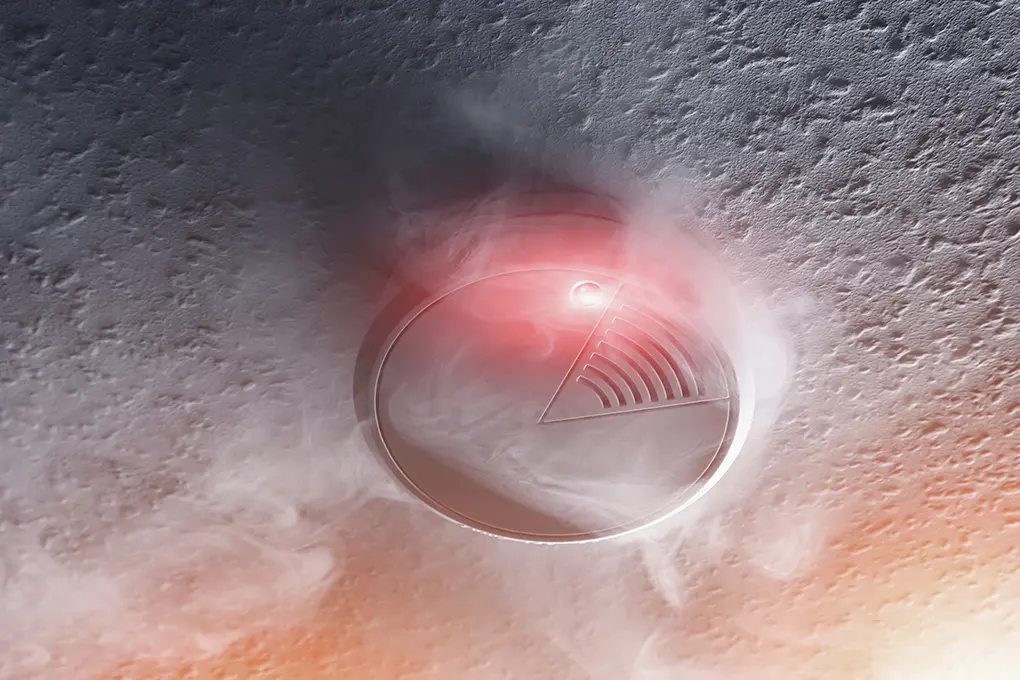
Picking between X-Sense and Kidde isn’t a minor preference call – it’s a choice between two different philosophies of home fire safety. According to NFPA data reported by Firehouse Magazine, working smoke alarms cut the risk of dying in a home fire by over 60%. Yet nearly 59% of home fire deaths still happen in homes with no alarms or non-working ones.
Kidde has been manufacturing fire safety products since 1917 and remains a household name at Home Depot, Lowe’s, and Walmart. X-Sense, a newer challenger, has earned top rankings from Bob Vila, SafeWise, and others with its LCD display, 10-year maintenance-free battery, and competitive pricing.
Both are genuinely good products. The right choice depends entirely on your home setup, budget, and whether you want hardwired reliability or a flexible battery-first system.
Table of Contents
- Key Takeaways
- X-Sense Models Reviewed
- Kidde Models Reviewed
- X-Sense vs Kidde: Full Model Comparison Table
- Which Brand Wins for X-Sense vs Kidde in Specific Scenarios?
- X-Sense vs Kidde Recall History: What Buyers Need to Know
- 3-Year Total Cost of Ownership: X-Sense vs Kidde
- Choosing the Right X-Sense or Kidde Alarm for Your Home
- Frequently Asked Questions
- Sources Used for This Article
Key Takeaways
- X-Sense is best for renters, apartments, and anyone who wants a 10-year sealed battery with an LCD display and no ongoing costs; Kidde is better for hardwired interconnected systems and users who need voice alerts with decades of brand credibility.
- X-Sense’s SC07 and SC07-W models offer both photoelectric smoke and electrochemical CO detection in one unit – the dual-sensor approach experts recommend for catching both smoldering and flaming fires.
- Kidde’s smart model (P4010ACSCO-WF) tested as one of the fastest-responding alarms in independent testing, producing an alarm within 10 seconds of smoke exposure.
- Kidde has faced multiple CPSC recalls – including the TruSense series (2021) and dual-sensor models PI2010/PI9010 (2018) – affecting hundreds of thousands of units; X-Sense has no major recall history, though some models lack NRTL/UL certification.
- Browse Batten’s expert-tested smoke and CO detector collection including the X-Sense SC07 combo alarm and X-Sense XC01-R CO detector for low-maintenance, high-value home protection.
X-Sense Models Reviewed
X-Sense organizes its lineup by connectivity – standalone, wireless interconnected, and Wi-Fi smart. Here are the four models worth knowing.
X-Sense SC07: Best Standalone Combo Alarm for Families
The SC07 is the brand’s flagship standalone combo alarm and the model that consistently tops independent best-of lists. Bob Vila ranked it best overall for battery-powered smoke detectors in 2025, and SafeWise named it a top pick for its combination of features and price.
X-Sense SC07 at a Glance
- Price: ~$35–$45/unit (as of February 2026)
- Detection: Photoelectric smoke + electrochemical CO
- Power: 10-year sealed lithium battery (non-replaceable)
- Display: LCD showing real-time CO PPM levels
- Alarm: 85 dB
- Interconnection: None (standalone)
- Smart Features: None
- Buy: X-Sense SC07 on batten.shop
The sealed 10-year battery is the headline feature – and it actually matters more than most buyers realize. According to NFPA data, battery problems are the most common reason smoke alarms fail to operate during fires. A sealed 10-year lithium battery eliminates that failure mode entirely for a decade.
The LCD display goes beyond a simple indicator light. You can see whether CO is at 45 PPM (borderline, worth investigating) or 200 PPM (evacuate immediately). Most competing alarms just beep at 70 PPM with no context.
The SC07 also samples air three times before triggering the alarm – a false-alarm reduction feature that matters in kitchens. The key limitation: it’s standalone. One SC07 will not wake up alarms in other rooms. For multi-room coverage, you need the SC07-W below.
Pros and Cons
Pros:
- 10-year sealed battery eliminates the #1 reason alarms fail
- LCD shows real-time CO levels in PPM for better situational awareness
- Photoelectric sensor excels at catching slow, smoldering fires
- Triple air sampling reduces false alarms from cooking and steam
- Lower per-unit cost than most comparable combo alarms
Cons:
- No wireless interconnection – standalone only
- No voice alerts to distinguish smoke from CO during an alarm
- Verify UL listing on packaging before purchasing for code compliance

X-Sense XC01-R: Best Standalone CO Detector with LCD
For homes that already have smoke-only alarms and want to add dedicated CO protection, the X-Sense XC01-R is the standout choice in the brand’s lineup.
X-Sense XC01-R at a Glance
- Price: ~$23–$29/unit (as of February 2026)
- Detection: Electrochemical CO only (no smoke detection)
- Sensor: Figaro electrochemical CO sensor
- Power: Replaceable CR123A battery (~5 years)
- Display: LCD showing real-time CO PPM + peak value memory
- Alarm: 85 dB
- Certification: UL 2034
- Buy: X-Sense XC01-R on batten.shop
Two features set the XC01-R apart from basic CO detectors. First, it uses a Figaro electrochemical sensor – a premium sensor brand known for accuracy and stability. Second, it has peak value memory: the LCD shows you the highest CO concentration recorded since the last reset. If you come home to find the detector in alarm and wonder what happened while you were out, the peak reading gives you real data to share with first responders or your HVAC technician.
Note that the XC01-R uses a replaceable CR123A battery with roughly a 5-year lifespan – not a sealed 10-year battery. The device itself is rated for 10 years of sensor operation, but you’ll replace the battery at the midpoint. That’s a meaningful maintenance commitment compared to the SC07’s sealed design, but it also means the XC01-R remains useful in states like California and New York that require removable batteries in some contexts.
Pros and Cons
Pros:
- Figaro electrochemical sensor delivers high accuracy and fast response
- LCD with peak value memory gives context after an alarm event
- UL 2034 certified – code-compliant for most jurisdictions
- Compact, tabletop or wall-mount design works anywhere near sleeping areas
- Lowest-cost entry point in the X-Sense lineup
Cons:
- CO detection only – requires a separate smoke alarm
- Replaceable battery (CR123A) rather than sealed 10-year design
- No wireless interconnection or smart features

X-Sense SC07-WX: Best Wi-Fi Smart Combo Alarm
The SC07-WX brings Wi-Fi connectivity directly to the SC07 platform – no hub required. It connects to your home’s 2.4 GHz network and sends push notifications to the X-Sense Home Security app whenever smoke or CO is detected, even when you’re away.
X-Sense SC07-WX at a Glance
- Price: ~$45/unit (as of February 2026)
- Detection: Photoelectric smoke + Figaro electrochemical CO
- Power: Replaceable CR123A battery
- Display: LCD (CO PPM, Wi-Fi status, battery)
- Alarm: 85 dB
- Interconnection: None – units do not interconnect with each other
- Smart Features: Direct Wi-Fi (2.4 GHz), X-Sense app, real-time alerts, device sharing with up to 12 users
- Optional Monitoring: Protect+ Premium subscription for 24/7 professional monitoring
The SC07-WX is the right pick for homeowners who travel frequently or want remote visibility into what’s happening at home. App setup is direct – scan the QR code, connect to Wi-Fi, and you’re live. Notifications arrive within about 20 seconds of an alarm triggering, based on independent testing by The Gadgeteer.
The key trade-off is interconnection: SC07-WX units operate independently and cannot link with each other wirelessly. Each unit sends its own separate app notification. If you want both Wi-Fi alerts and whole-home interconnection, you’ll need the SC07-MR with the SBS50 base station – a more expensive setup.
Also note: the SC07-WX uses a replaceable battery, not the sealed 10-year design. Several states – including New York, California, and Massachusetts – require non-removable batteries in smoke alarms. Verify local code requirements before purchasing.
Pros and Cons
Pros:
- Direct Wi-Fi connection – no hub or base station required
- Real-time app push notifications when away from home
- Device sharing with up to 12 family members
- Optional professional monitoring via Protect+ subscription
Cons:
- No wireless interconnection between units – each is fully standalone
- Replaceable battery not permitted in some states (NY, CA, MA, others)
- No voice alerts
For more information on smoke detectors, read our X-Sense vs Nest protect review.
Kidde Models Reviewed
Kidde’s lineup runs from simple 9V ionization alarms to hardwired smart detectors with Wi-Fi, app control, and voice alerts. Here are four current models covering the range.
Kidde i9050: Best Budget Smoke Alarm for Straightforward Protection
The i9050 is Kidde’s most recognized basic smoke alarm and one of the best-selling smoke detectors in North America. Bob Vila ranked it best budget smoke alarm, noting it sounded within 25 seconds in testing and was easier to silence than alarms costing four times as much.
Kidde i9050 at a Glance
- Price: ~$8–$12/unit (as of February 2026)
- Detection: Ionization smoke only (no CO detection)
- Power: 9V replaceable battery (included)
- Display: Red LED indicator only
- Alarm: 85 dB
- Interconnection: None
- Certification: UL Listed
- Note: Being phased out – current replacement model is the 20SDR
The i9050 is a workhorse alarm that does exactly what it says. Ionization technology detects the invisible fire particles from fast-flaming fires – think a kitchen grease fire or burning curtains – faster than photoelectric sensors. The tradeoff is that ionization alarms are slower to detect smoldering fires (the type most likely to kill sleeping occupants) and are more prone to false alarms from cooking. Kidde itself recommends pairing ionization alarms with photoelectric models for complete protection.
The i9050 requires annual 9V battery replacement – a cost and maintenance commitment that adds up over time compared to 10-year sealed designs. It also produces no CO detection whatsoever. For straightforward, budget-friendly fire protection in a single room or as a supplemental alarm, it remains a solid choice. For comprehensive protection, look elsewhere in this list.
Pros and Cons
Pros:
- Lowest cost per unit – budget-friendly for equipping an entire home
- UL Listed with a reliable 10-year limited warranty
- Fast detection of flaming fires via ionization technology
- Simple installation – no wiring, no pairing, no setup
Cons:
- Ionization only – detection gap for slow-smoldering fires
- No CO detection
- Annual 9V battery replacement required
- No display, no interconnection, no smart features
Kidde 20SD10: Best 10-Year Battery Smoke Alarm for Low Maintenance
The 20SD10 is Kidde’s current-generation standalone battery smoke alarm, built to the latest UL 217 9th Edition standard. It replaces older models like the i9050 with enhanced sensing technology and a 10-year sealed battery that eliminates the annual battery hassle.
Kidde 20SD10 at a Glance
- Price: ~$20–$28/unit (as of February 2026)
- Detection: Photoelectric smoke only (no CO)
- Power: 10-year sealed lithium battery
- Display: 3-color LED (green = normal, amber = error, red = alarm)
- Alarm: 85 dB + self-testing
- Interconnection: None (standalone)
- Certification: UL 217 9th Edition, FCC
The 20SD10 is a meaningful step up from the i9050. Switching to photoelectric detection addresses the smoldering fire gap, and the 10-year sealed battery removes the annual replacement requirement. The 3-color LED system gives a quick visual check on status – something the i9050 lacked entirely. Self-testing components run continuous checks without requiring the user to press the test button, though Kidde still recommends a manual button test once a week.
The 20SD10 doesn’t interconnect with other alarms and has no CO detection. For homeowners who want a clean, no-maintenance upgrade to basic coverage – one alarm per bedroom, one in the hallway – it delivers reliable photoelectric protection at a mid-range price. The lack of CO detection means you’ll still need dedicated CO alarms or combo units elsewhere in the home.

Pros and Cons
Pros:
- 10-year sealed battery with no annual replacements
- Photoelectric sensor catches slow smoldering fires effectively
- 3-color LED provides instant visual status at a glance
- UL 217 9th Edition compliance – the current detection standard
Cons:
- No CO detection – requires separate CO alarms
- No interconnection capability
- No voice alerts or display showing hazard specifics
Kidde 30CUA10-V: Best Hardwired Combo Alarm with Voice Alerts
The 30CUA10-V is Kidde’s flagship hardwired combo alarm – the model most installers and contractors reach for when equipping new construction or renovating an existing hardwired system. It combines photoelectric smoke and electrochemical CO detection with voice alerts and hardwired interconnection.
Kidde 30CUA10-V at a Glance
- Price: ~$35–$50/unit (as of February 2026)
- Detection: Photoelectric smoke + electrochemical CO
- Power: 120V AC hardwired + 10-year sealed lithium backup battery
- Display: LED indicator lights
- Alarm: 85 dB + voice alerts (“Fire!” / “Warning! Carbon Monoxide!”)
- Interconnection: Yes – hardwired to up to 24 Kidde devices
- Certification: UL Listed
Voice alerts are the 30CUA10-V’s defining feature. When smoke triggers the alarm, it announces “Fire!” clearly over the 85 dB siren. When CO triggers, it announces “Warning! Carbon Monoxide!” This distinction genuinely matters during an emergency – you react differently to fire than to CO poisoning, and a simple beep gives you no information about which hazard you’re facing.
The hardwired architecture means you’ll need either existing hardwired smoke alarm wiring or an electrician. The quick-connect wiring harness makes installation straightforward for electricians, and the 10-year sealed lithium backup battery keeps the alarm functioning during power outages without any battery maintenance. Up to 24 Kidde devices can be interconnected via the hardwired line. When one alarm triggers, every alarm in the house fires simultaneously.
Pros and Cons
Pros:
- Voice alerts clearly identify fire vs. CO – critical for correct emergency response
- Hardwired interconnection covers the entire home through existing wiring
- 10-year backup battery handles power outages with no maintenance
- Photoelectric + electrochemical CO dual detection covers both hazard types
Cons:
- Requires hardwired installation – not suitable for renters or no-wire retrofits
- No Wi-Fi or remote app notifications
- Higher per-unit cost than battery-only models

X-Sense vs Kidde: Full Model Comparison Table
| Model | Brand | Price | Detection | Power | Interconnection | Smart/App | Voice Alerts | UL Certified |
| SC07 | X-Sense | ~$40 | Smoke + CO | 10-yr sealed | None | None | No | Verify |
| XC01-R | X-Sense | ~$25 | CO only | 5-yr replaceable | None | None | No | UL 2034 |
| SC07-WX | X-Sense | ~$45 | Smoke + CO | Replaceable | None | Wi-Fi + app | No | Verify |
| i9050 | Kidde | ~$10 | Smoke only | 9V replaceable | None | None | No | Yes |
| 20SD10 | Kidde | ~$25 | Smoke only | 10-yr sealed | None | None | No | UL 217 Ed.9 |
| 30CUA10-V | Kidde | ~$45 | Smoke + CO | AC + 10-yr backup | Hardwired (24 units) | None | Yes | Yes |
Which Brand Wins for X-Sense vs Kidde in Specific Scenarios?
The right answer depends entirely on your situation. Here’s where each brand clearly wins:
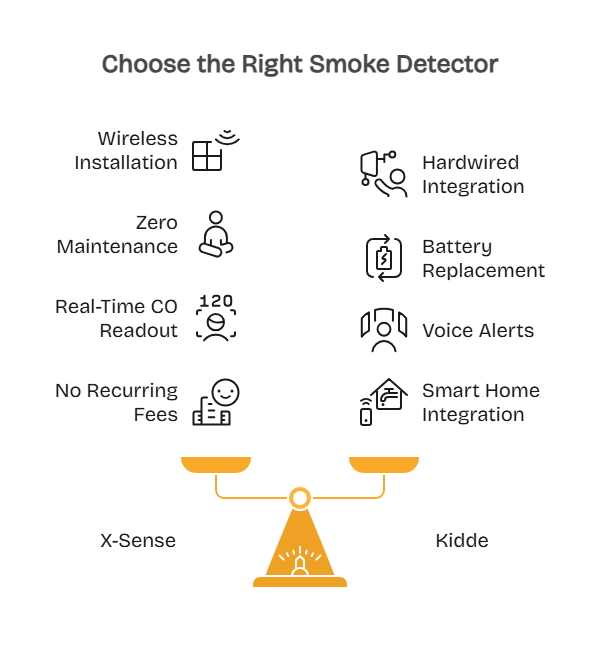
X-Sense wins for:
- Renters and Apartments:No wiring required, wireless interconnection works without touching the electrical system
- Large Homes Needing Many Units: Lower per-unit cost, connect up to 24 wirelessly with no recurring fees
- Zero-Maintenance Homeowners:The SC07’s 10-year sealed battery means 10 years without opening the unit
- Anyone Who Wants Real-Time CO Readout: No basic Kidde model provides live PPM readings like X-Sense’s LCD
Kidde wins for:
- New Construction and Hardwired Homes:Deeply integrated ecosystem with whole-home hardwired coverage
- Users Who Need Voice Alerts: The 30CUA10-V and P4010ACSCO-WF announce “Fire!” vs. “Warning! Carbon Monoxide!” rather than just beeping
- Smart Home Integration:Alexa, Google Home, and the Kidde app put the P4010ACSCO-WF in a class of its own
- Existing Kidde Hardwired Systems: Adding or upgrading within a Kidde ecosystem is seamless
For rental properties and landlords, X-Sense makes particular sense. You can equip an entire unit inexpensively, meet code requirements with photoelectric + CO combo protection, and install everything without touching a wire. Read our guide on how many smoke and carbon monoxide detectors you need to plan your placement strategy before purchasing.
X-Sense vs Kidde Recall History: What Buyers Need to Know
Kidde’s recall record deserves direct attention. The brand has faced two significant CPSC recalls in recent years.
According to the U.S. Consumer Product Safety Commission, Kidde recalled the TruSense Model Series 2040–2070 in 2021 after finding units could delay detection or fail to detect smoke entirely. Approximately 226,000 units were affected. In 2018, Kidde recalled an additional 452,000 dual-sensor smoke alarms (models PI2010 and PI9010) after a manufacturing defect covered a sensor. These are historical issues with specific product lines – current DETECT series models are not under recall and carry UL 217 9th Edition certification.
X-Sense has no major CPSC recalls on record. That said, the brand is newer with a smaller installed base, and a 2025 review by Product Review Crew notes that some X-Sense models are not NRTL-listed. Always verify the UL or ETL listing on the packaging before purchasing, especially for rental properties, new construction, or homes in jurisdictions with strict code requirements.
3-Year Total Cost of Ownership: X-Sense vs Kidde
| Setup | Hardware (5 units) | Battery Cost (3 yrs) | Total 3-Year Cost |
| X-Sense SC07 standalone | ~$200 | $0 (sealed) | ~$200 |
| X-Sense SC07-W interconnected | ~$225 | $0 (sealed) | ~$225 |
| Kidde i9050 ionization | ~$50 | ~$45 (annual 9V) | ~$95 |
| Kidde 20SD10 battery combo | ~$125 | $0 (sealed) | ~$125 |
| Kidde 30CUA10-V hardwired | ~$225 | $0 (sealed backup) | ~$225+ (electrician cost) |
| Kidde P4010ACSCO-WF smart | ~$375 | $0 (sealed backup) | ~$375+ (electrician cost) |
The Kidde i9050 wins on hardware cost alone, but it’s ionization-only – it leaves a detection gap for smoldering fires. Comparing full photoelectric + CO protection, the X-Sense SC07 and Kidde 20SD10 are both strong value propositions. X-Sense wins the battery cost battle; Kidde wins on UL certification breadth and ecosystem depth.
Choosing the Right X-Sense or Kidde Alarm for Your Home
The SC07-W is the right call for most renters, apartment dwellers, and homeowners who want comprehensive interconnected coverage without an electrician. The 10-year sealed battery, real-time CO display, and wireless whole-home interconnection hit every major protection need at a price that makes full-home coverage affordable.
The Kidde 30CUA10-V is the right call for homeowners building or upgrading a hardwired system – voice alerts, hardwired interconnection, and proven UL certification across a lineup that spans from budget to smart. If you want the smart layer on top, the P4010ACSCO-WF adds remote monitoring, Alexa and Google Home integration, and one of the fastest detection times in independent testing.
For a complete home safety setup, also see our guides on the SimpliSafe smoke detector for monitored system integration and self-monitored security systems if you want everything centrally managed. If you already have a Kidde system, check out our Kidde fire escape ladder review for complementary safety products from the brand.
Ready to protect your home with expert-tested smoke and CO alarms? Browse Batten’s smoke detector collection.
Frequently Asked Questions
Is X-Sense or Kidde Better for X-Sense vs Kidde Smoke Detection Reliability?
Both brands use industry-standard photoelectric sensors in their combo models. Kidde’s smart P4010ACSCO-WF responds to smoke in about 10 seconds in independent testing; X-Sense’s SC07 responds in about 25 seconds. Kidde carries NRTL/UL certification across its full lineup; some X-Sense models may not. Verify the specific model’s certification before purchasing for rental or code compliance.
Do X-Sense Smart Smoke Detectors Connect to Wi-Fi?
Yes, but only specific models. The SC07-WX connects directly to 2.4 GHz Wi-Fi without a hub and sends push notifications through the X-Sense Home Security app. The SC07-MR uses a separate SBS50 hub for app connectivity and supports wireless interconnection simultaneously. The SC07-W uses RF for interconnection only – no internet. The base SC07 is entirely standalone.
What Are the Main Differences Between X-Sense and Kidde Sensor Types?
X-Sense standardizes on photoelectric smoke sensors – better for slow, smoldering fires. Kidde offers ionization, photoelectric, and dual-sensor models – pick the wrong one and you leave a detection gap. The Kidde 20SD10 and 30CUA10-V both use photoelectric smoke sensors. The i9050 uses ionization only. For full fire type coverage, choose photoelectric + CO combo models from either brand.
Are Kidde Smoke Alarms Still Safe to Buy After Past Recalls?
Yes, with caution. The recalled models – TruSense 2040–2070 and dual-sensor PI2010/PI9010 – were specific product lines, not the entire brand. Current Kidde DETECT models including the 20SD10, 30CUA10-V, and P4010ACSCO-WF are not under recall and are UL 217 9th Edition compliant. Before buying, verify model numbers at Kidde’s product safety notices page.
Which X-Sense vs Kidde Smoke Detector Is Best for Apartments and Renters?
X-Sense wins clearly for renters. The SC07 or SC07-W requires no wiring, installs in minutes, and the 10-year sealed battery means no landlord headaches from dead batteries. Note that several states including New York, California, Massachusetts, and others require non-removable 10-year batteries or hardwired systems – the SC07 and SC07-W meet this requirement; the SC07-WX does not.
Does Kidde Have a Smoke Detector with No Subscription Fees?
Yes – every Kidde model reviewed here requires no subscription. The i9050, 20SD10, 30CUA10-V, and P4010ACSCO-WF all function fully without ongoing fees. The Kidde app for the P4010ACSCO-WF is free to use for remote monitoring and alerts. Subscriptions are only a factor if you add third-party professional monitoring services separately.
How Long Do X-Sense vs Kidde 10-Year Batteries Actually Last?
Both brands’ sealed lithium batteries are rated for 10 years based on weekly self-test cycles under normal operating conditions. Both will alert you with an end-of-life chirp or notification when the battery nears depletion. One practical difference: X-Sense combo models (SC07, SC07-W) run both smoke and CO sensors for the full 10 years from the same sealed unit. Kidde combination units may be rated at 7–10 years depending on the specific model – check the product label.
Sources Used for This Article
- “Smoke Alarms in U.S. Home Fires: Working Smoke Alarms Reduce Risk of Death by 60%,” 2024, Firehouse Magazine / NFPA, https://www.firehouse.com/community-risk/community-risk-reduction/press-release/55142736/nfpa-national-fire-protection-association-latest-us-smoke-alarm-data-reinforces-critical-importance-of-fire-prevention-week
- “Kidde Recalls TruSense Smoke and Combination Smoke/Carbon Monoxide Alarms,” 2021, U.S. Consumer Product Safety Commission, https://www.cpsc.gov/Recalls/2021/Kidde-Recalls-TruSense-Smoke-and-Combination-Smoke-Carbon-Monoxide-Alarms-Due-to-Risk-of-Failure-to-Alert-Consumers-to-a-Fire
- “Kidde Recalls Dual Sensor Smoke Alarms Due to Risk of Failure to Alert Consumers to a Fire,” 2018, U.S. Consumer Product Safety Commission, https://www.cpsc.gov/Recalls/2018/Kidde-Recalls-Dual-Sensor-Smoke-Alarms-Due-to-Risk-of-Failure-to-Alert-Consumers-to-a-Fire
- “We Tested the Best Smoke Detectors-Here Are the Top Picks for Your Home,” 2025, Bob Vila, https://www.bobvila.com/reviews/best-smoke-detectors-2025/
- “Keep Your Home and Family Safe With One of Our Favorite Smoke Detectors,” 2025, Bob Vila, https://www.bobvila.com/articles/best-smoke-detector/
- “Best Smart Smoke Detectors 2026,” 2024, TechHive, https://www.techhive.com/article/583050/best-smart-smoke-detector.html
- “X-Sense SC07-MR Smart Smoke & Carbon Monoxide Alarm Review,” 2025, Reviewed.com, https://www.reviewed.com/smarthome/content/x-sense-sc07-mr-review-smart-smoke-carbon-monoxide-alarm
- “Best Smoke Detectors,” 2025, SafeWise, https://www.safewise.com/resources/smoke-alarm-buyers-guide/
- “Kidde vs. First Alert vs. X-Sense – Best Battery-Powered Combination Smoke and Carbon Monoxide Alarms,” 2025, Alarm Opinion, https://alarmopinion.com/kidde-vs-first-alert-vs-x-sense/
- “X-Sense SC07-WX Wi-Fi Connected Smoke and Carbon Monoxide Detector Review,” 2024, The Gadgeteer, https://the-gadgeteer.com/2024/01/10/x-sense-sc07-wx-wi-fi-connected-smoke-and-carbon-monoxide-detector-review-know-whats-happening-even-when-youre-not-at-home/
- “Best Smoke Detectors 2026: Top 5 Ranked and Reviewed,” 2025, Product Review Crew, https://www.productreviewcrew.com/review/best-smoke-detectors-compared
- “House Fire Statistics: Trends, Risks, and Causes,” 2025, Insurify, https://insurify.com/homeowners-insurance/insights/house-fire-statistics/
- “Smoke Alarms in U.S. Home Fires,” NFPA Research Report, NFPA, https://www.nfpa.org/education-and-research/research/nfpa-research/fire-statistical-reports/smoke-alarms-in-us-home-fires
- “Kidde Product Safety Notices,” 2025, Kidde, https://www.kidde.com/product-safety-notices
- “KIDDE P4010ACSCO-WF Smoke + Carbon Monoxide Alarm with Smart Features,” Ready Wholesale Electric Supply, https://readyelectricsupply.com/products/kidde-p4010acsco-wf-smoke-carbon-monoxide-alarm-with-smart-features