
Quick Answer: The most effective DIY door frame reinforcement methods are upgrading to 3-inch screws, installing a heavy-duty strike plate, adding door jamb reinforcement plates, reinforcing hinges, and fitting a door security bar or alarm – each stopping kick-ins by addressing the specific weak points burglars exploit most.
A locked door won’t stop a kick-in. Most fail in seconds because the frame, not the door, is the weakest point.
The good news is you don’t need a full replacement to fix it. A few targeted upgrades can turn a vulnerable entry point into something far harder to break through. This guide walks through five DIY methods that reinforce the exact spots burglars exploit, from the strike plate to the hinges, along with renter-friendly options that require zero installation.
Table of Contents
- Key Takeaways
- Why Standard Door Frames Fail During Kick-Ins
- Method 1: Upgraded Strike Plate and 3-Inch Screw Reinforcement
- Method 2: Door Jamb Reinforcement Plates
- Method 3: Hinge Reinforcement Techniques
- Method 4: Door Security Bars and Wedge Alarms
- Method 5: Door Frame Repair and Strengthening
- Cost Comparison: DIY Door Reinforcement Methods
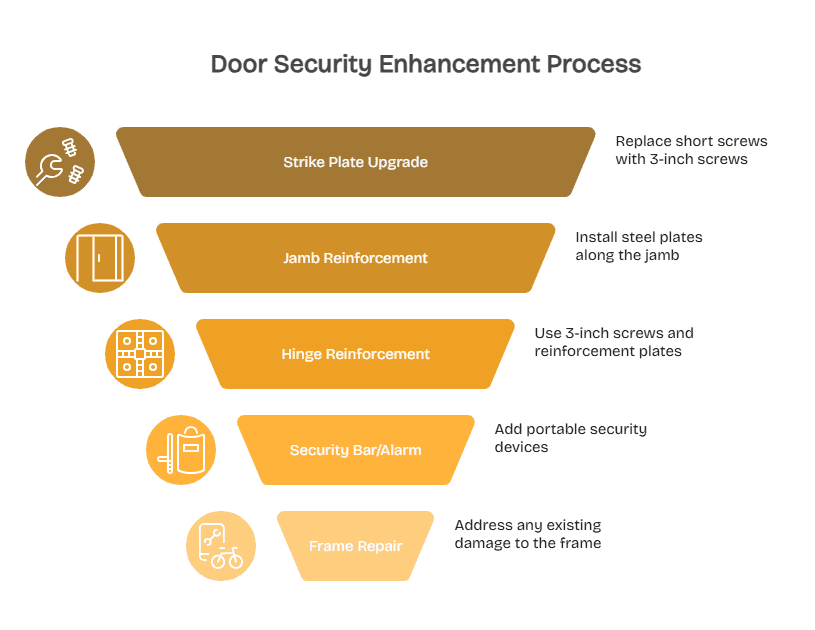
- Combining Methods for Maximum Kick-In Prevention
- Tools Needed for Door Frame Reinforcement
- Making the Right Call for Your Door
- Frequently Asked Questions
- Sources
Key Takeaways
- The single most effective kick-in prevention measure is replacing standard ½-inch factory screws with 3-inch hardened steel screws that anchor into wall studs – not just the jamb.
- According to Advisement’s burglary research, about 50% of all burglaries involve forced entry, making door reinforcement one of the highest-ROI upgrades a homeowner can make.
- The Buddybar Door Jammer withstands up to 2,560 lbs of force and requires zero installation – ideal for renters and homeowners alike.
- The SABRE Wedge Door Stop Alarm adds a 120 dB alert to any inward-swinging door in seconds, combining physical resistance with noise deterrence.
- Browse Batten’s home security hardware collection for expert-vetted door security products that work whether you own or rent.
Why Standard Door Frames Fail During Kick-Ins
Your front door probably looks solid. It isn’t.
Most builder-grade door frames use pine trim anchored with half-inch screws that only penetrate the jamb – not the structural studs behind it. A focused kick concentrates roughly 150-200 lbs of force directly at the lock strike, and that soft wood splits in under 10 seconds. According to FBI data compiled by MoneyGeek, front doors account for 34% of all burglary entry points, making them the biggest physical vulnerability in any home.
The failure points follow a predictable pattern every time:
- Strike Plate Area: Where the deadbolt enters the frame; short screws let the jamb explode outward on impact
- Hinge Side: Often ignored, but a kick here shears screws and pops the door free
- Door Edge: Thin wood around the lock mortise splits when the bolt is driven sideways
Every one of these failure points can be addressed with DIY hardware costing $15-$150 per door.
Method 1: Upgraded Strike Plate and 3-Inch Screw Reinforcement
Cost: $5-$40 | Time: 15-20 minutes | Renter-Friendly: No (permanent)
This is the fastest, cheapest upgrade with the biggest single improvement for door kick-in prevention.
The standard strike plate shipped with most deadbolts uses two short screws that barely grip the jamb. Replace those screws with 3-inch hardened steel screws that drive through the jamb and deep into the structural wall stud behind it. This one change transfers kick force from weak pine trim into your home’s load-bearing frame.
What to do:
- Remove the existing strike plate
- Pre-drill pilot holes to prevent wood splitting
- Drive 3-inch screws through the plate, through the jamb, and into the wall stud
- For a full upgrade, replace the standard plate with a heavy-duty reinforced strike plate (typically 3-6 inches long with four or more screw holes)
- Verify the deadbolt operates smoothly before finishing
For maximum strike zone protection, look for heavy-duty strike plates with extended faceplates – the longer the plate, the more force is distributed across the frame rather than concentrated at one bolt point.
Pro tip: Treat both the deadbolt strike and the latch strike. Many homeowners reinforce only the deadbolt and leave the latch strike on original short screws – a kick aimed at the latch can still split the frame.
Method 2: Door Jamb Reinforcement Plates
Cost: $30-$60 | Time: 30 minutes | Renter-Friendly: Partial
Strike plate upgrades handle the bolt area. Door jamb reinforcement plates handle the entire lock-side frame – a longer steel channel that prevents wood from splintering even when force is applied above or below the lock.
These plates typically run 18-48 inches along the jamb and attach with multiple 3-inch screws spaced across the full length. Force from a kick gets distributed along the entire plate rather than at one small point. Even a heavy kick finds nowhere to concentrate enough energy to split the frame.
The jamb itself is usually just ¾-inch pine trim. Without reinforcement, it’s the first thing to fail – and a splintered jamb defeats even a Grade 1 deadbolt, because the bolt is only as secure as the wood holding it.
What to Look for in a Jamb Plate
- Steel Gauge: 16 or 18 gauge galvanized steel minimum – thinner is not worth installing
- Length: Longer coverage means better force distribution; 36 inches or more is ideal for exterior doors
- Screw Pattern: Look for four or more mounting holes so force is spread across the full plate length
- Finish Options: Most quality plates come in satin nickel, oil-rubbed bronze, and matte black to match existing hardware
For renters considering this method: the screw holes are small and can be patched and painted on move-out, making this semi-reversible with basic repair skills.

Method 3: Hinge Reinforcement Techniques
Cost: $15-$35 | Time: 20-30 minutes | Renter-Friendly: No (permanent)
Most homeowners never think about the hinge side of the door. Burglars sometimes do.
A door with three exposed hinges can be forced open by kicking the hinge side, shearing the short factory screws that hold each hinge leaf to the frame. The fix is the same principle as the strike plate: replace factory ½-inch screws with 3-inch screws that anchor into the structural stud.
For maximum hinge security:
- Replace at least two screws per hinge with 3-inch hardened steel screws
- Treat all three hinges – not just the top or bottom
- Add L-shaped hinge reinforcement plates for doors in high-risk areas
If your door swings outward – uncommon in the US but possible on older homes – hinge pins are exposed and can be driven out. In that case, add security hinge bolts: small steel pins that interlock both sides of the hinge so the door can’t be lifted free even with the pins removed.
For renters wanting to pair physical hinge security with access control, check out our guide on best smart locks for rental properties – smart locks add a digital layer on top of the mechanical hardening from hinge work.
Method 4: Door Security Bars and Wedge Alarms
Cost: $15-$120 | Time: Under 5 minutes | Renter-Friendly: Yes – zero installation
This is the method that works for everyone, including renters who can’t drill a single screw. Door security bars and wedge alarms don’t modify the door or frame at all – they create a physical barrier or alert that activates the moment someone tries to push the door open.
Buddybar Door Jammer at a Glance
- Price: $109.95 on Batten (as of March 2026)
- Force Resistance: Up to 2,560 lbs
- Material: Powder-coated steel – no plastic parts
- Adjustable Length: 36 to 51 inches to fit most door heights
- Floor Compatibility: Carpet, tile, vinyl, concrete, wood
- Buy: Buddybar Door Jammer at Batten

The Buddybar Door Jammer is one of the strongest portable door security bars available. It wedges at an angle between the door handle and the floor, and its rubber-coated foot grips any surface without damage. At 2,560 lbs of rated force resistance, no kick-in attempt is getting through. Setup takes seconds – angle it into place and it’s locked. Remove it in one motion. There’s nothing to install, no tools required, and no damage to your door or floor.
SABRE Wedge Door Stop Alarm at a Glance
- Price: $14.99 on Batten (as of March 2026)
- Alarm Volume: 120 dB
- Trigger: Pressure applied to the door
- Power: Battery operated
- Best For: Bedrooms, hotel rooms, dorm rooms, apartments
- Buy: SABRE Wedge Door Stop Alarm at Batten
The SABRE Wedge Door Stop Alarm slides under any inward-swinging door. When pressure is applied – whether from a kick attempt or someone pushing the door – it triggers a 120 dB alarm instantly. At that volume, it wakes everyone in the home and deters most intruders within seconds. It’s battery-operated, completely portable, and requires zero installation. At $14.99, it’s the most affordable entry point in door security.

Pros and Cons: Buddybar vs. SABRE Wedge Alarm
Buddybar Door Jammer Pros:
- Rated to 2,560 lbs – serious physical barrier
- All-steel construction, no plastic to break or crack
- Works on any floor surface without damage
Buddybar Door Jammer Cons:
- Must be manually set each time (not passive protection)
- Does not alert you – it just blocks
SABRE Wedge Alarm Pros:
- 120 dB alarm deters and alerts simultaneously
- Portable and perfect for travel, hotels, and dorms
- Under $15 – lowest cost option in this guide
SABRE Wedge Alarm Cons:
- Physical resistance is lower than a steel bar
- Requires battery replacement over time
Method 5: Door Frame Repair and Strengthening
Cost: $20-$50 in materials | Time: 1-2 hours | Renter-Friendly: No
If your door frame already shows splits, gaps, or damage from a previous forced entry attempt – or just years of settling – reinforcement hardware won’t perform as designed on top of damaged wood. Repair first.
Assessing the Damage
Run your hands along the jamb at the strike plate area and check for:
- Visible cracks or splits in the wood
- Gaps between the jamb and the rough frame behind it
- Old paint that moves or buckles when pressed
Repair Steps
Minor splits respond well to wood filler: pack the area, allow full cure (24 hours), and sand flush before installing any hardware. For serious splits where the jamb has separated from the rough frame, use wood glue and clamp firmly overnight, then reinforce with 3-inch screws through the repair into the stud.
For hollow metal frames common in apartments and condos, the Steel Door Institute’s installation guidelines outline appropriate anchoring methods – these frames require different hardware than wood jambs, and using wood-specific products on metal frames defeats the upgrade.
After repair, add upgraded strike plate screws and either a door security bar or jamb reinforcement plate to prevent re-damage.

Cost Comparison: DIY Door Reinforcement Methods
| Method | Cost Range | Install Time | Renter-Friendly | Coverage |
| 3-Inch Screw Upgrade | $5-$15 | 15 min | No | Hinges + strike only |
| Heavy-Duty Strike Plate | $20-$40 | 20 min | No | Strike area |
| Door Jamb Reinforcement Plate | $30-$60 | 30 min | Partial | Lock-side jamb |
| Hinge Reinforcement Plates | $15-$35 | 20 min | No | Hinge side |
| Buddybar Door Jammer | $109.95 | Under 5 min | ✅ Yes | Full door resistance |
| SABRE Wedge Door Stop Alarm | $14.99 | Under 5 min | ✅ Yes | Alert + resistance |
Combining Methods for Maximum Kick-In Prevention
Each method above addresses a specific failure point. Combining them creates layered protection with no single weak spot remaining.
Best combination for homeowners (full permanent protection, $80-$120 total): Replace all strike plate and hinge screws with 3-inch screws, add a door jamb reinforcement plate for full lock-side coverage, and keep a Buddybar Door Jammer for nighttime use. This combination eliminates every structural weak point and adds active resistance during the hours intrusion risk is highest.
Best combination for renters (no-drill, under $130): The Buddybar Door Jammer stops forced entry. The SABRE Wedge Door Stop Alarm under a bedroom door adds a 120 dB alert. Together they create serious deterrence with zero modifications to the property.
Door reinforcement is physical security. Layer it with detection by adding a video doorbell to monitor approach activity before a breach attempt, and consider whether your home security alarm system includes door and window sensors that alert you the moment entry is forced. Physical hardening buys critical time – monitoring and alarms summon help.
Tools Needed for Door Frame Reinforcement
Most methods require only tools you already own.
For screw upgrades and strike plate replacement:
- Power drill with Phillips and Torx bits
- 1/8-inch drill bit for pilot holes
- Tape measure and pencil
- Chisel (for adjusting mortise if new plate is slightly larger)
For jamb plate and hinge plate installation:
- Same drill and bit set
- Level (optional but helpful for long jamb plates)
For frame repair:
- Wood filler and putty knife
- 120-grit sandpaper
- Wood glue and clamps (for serious splits)
Making the Right Call for Your Door
Door frame reinforcement is one of the highest-ROI home security upgrades available. For as little as $15 and 15 minutes of work, you can meaningfully reduce your risk. For renters with no drilling allowed, the Buddybar Door Jammer and SABRE Wedge Alarm deliver serious protection with zero property modifications.
Reinforced doors don’t stop criminals from trying. They stop them from succeeding – and in home security, that’s the only outcome that matters. Read our guide on outdoor property security to extend this same layered approach beyond the front door.
Ready to stop a kick-in before it starts? Browse Batten’s home security hardware collection – including the Buddybar Door Jammer and SABRE Wedge Door Stop Alarm – for expert-vetted door security options that work whether you own or rent.
Frequently Asked Questions
Does Door Frame Reinforcement Actually Prevent Kick-Ins?
Yes – when properly installed, door frame reinforcement dramatically reduces kick-in success rates. The key is anchoring hardware into wall studs rather than just the decorative jamb. Products like the Buddybar Door Jammer are tested to 2,560 lbs of force resistance, far exceeding what any unassisted kick delivers. Physical hardening makes your door a time-consuming target that most intruders will abandon.
What Is the Single Best DIY Door Kick-In Prevention Upgrade?
Replacing short factory screws with 3-inch hardened steel screws at both the strike plate and hinges is the most impactful permanent upgrade per dollar spent – under $15 and 15 minutes. For a zero-installation option, the Buddybar Door Jammer at $109.95 provides 2,560 lbs of force resistance with no drilling required.
Can Renters Install Door Frame Reinforcement Without Damaging the Jamb?
Absolutely. The SABRE Wedge Door Stop Alarm slides under any inward-swinging door with zero installation – trigger a 120 dB alarm at the first push. The Buddybar Door Jammer requires no drilling and leaves no marks on floors or doors. For permanent upgrades, check with your landlord – most will approve screw replacements since they protect the property too.
How Do I Know If My Door Frame Needs Repair Before Reinforcement?
Check the jamb at the strike plate area for visible cracks, splits, or movement when pressed. Look for gaps between the jamb and the rough frame behind it, and for paint that buckles under light pressure. If you find damage, repair with wood filler or wood glue before installing any hardware – plates anchored into damaged wood won’t perform as rated.
Does Door Reinforcement Help Reduce Homeowners Insurance Premiums?
Security upgrades, including door hardening and alarm systems, can contribute to lower insurance costs. For the full picture on how physical and monitored security measures affect your premiums, read our guide on home security system insurance discounts.
What’s the Difference Between a Door Jammer and a Wedge Door Alarm for Preventing Kick-Ins?
A door jammer like the Buddybar is a pure physical barrier – heavy-duty steel rated to 2,560 lbs of force. A wedge alarm like SABRE triggers a 120 dB alert when pressure is applied. For maximum protection, use both: the jammer blocks forced entry while the alarm wakes you and deters the intruder simultaneously.
Are Steel Door Frames More Resistant to Kick-Ins Than Wood Frames?
Steel and fiberglass frames offer greater inherent resistance than wood, but still require proper stud anchoring to perform. Even metal frames need heavy-duty hardware with long screws to prevent failure. For metal frames in apartments or condos, follow the Steel Door Institute’s installation guidelines for appropriate anchoring – wood-specific reinforcement products won’t work correctly on metal.
Sources
- “US Home Burglary: Statistics, Facts and Trends,” 2026, MoneyGeek, https://www.moneygeek.com/resources/home-burglary-statistics/
- “Burglary Statistics: Rates, Trends & Facts,” 2026, Advisement, https://advisement.com/burglary-statistics/
- “How to Reinforce Doors for Maximum Security,” 2025, Premier Body Armor, https://premierbodyarmor.com/blogs/pba/reinforce-door-for-security
- “Two Post Strike Plate – Heavy Duty Door Reinforcement,” 2026, Tuff Strike, https://www.tuffstrike.com/products/two-post-strike-plate-door-reinforcement
- “Technical Documents,” 2025, Steel Door Institute, https://steeldoor.org/tech_data/
- “How to Reinforce Your Door Frame Against Break-Ins: A DIY Guide,” 2025, Driscoll’s Lock & Key, https://driscolllockandkey.com/how-to-reinforce-your-door-frame-against-break-ins-a-diy-guide/
- “Buddybar Door Jammer Security Bar,” 2026, Batten Safe, https://battensafe.com/product/buddybar-door-jammer-security-bar/
- “Sabre Wedge Door Stop Alarm,” 2026, Batten Safe, https://battensafe.com/product/sabre-wedge-door-stop-alarm/
- “Hardware Collection,” 2026, Batten Safe, https://battensafe.com/marketplace/home/hardware/
- “Home Security Alarm Systems,” 2026, Batten Safe, https://battensafe.com/marketplace/home/alarm-systems/