
Quick Answer: The biggest surveillance threats in 2026 come from everyday commercial tools, including data brokers, Bluetooth trackers, smart TVs, workplace monitoring software, and private license plate readers. These systems can collect and expose detailed location, biometric, and behavioural data. Start with a privacy audit to identify which risks affect your household, then adjust the relevant settings and habits.
Most people searching for information on surveillance technology threats are not privacy activists. They are a parent who found an unfamiliar Bluetooth tracker alert on their phone, a renter who realized their television has been fingerprinting everything on screen, or someone who just learned that a company they have never heard of has been selling their location history for years. The concern is specific and personal: who has my data, what can they do with it, and what do I change tonight?
That worry is widespread and getting worse rather than better. Pew Research Center found that 81% of Americans are concerned about how companies use the data collected about them, 71% say the same about government use, and roughly three-quarters feel they have very little or no control over any of it. The same research documented something more troubling than concern: 67% of adults say they understand little to nothing about what companies actually do with their personal data. That gap between worry and understanding is where real harm happens, because you cannot opt out of a system you cannot see.
Many of the households we work with are surprised to learn how much of this is commercial rather than governmental, and how much of it can be reduced in an afternoon with no new hardware at all.
Table of Contents
- Key Takeaways
- How Commercial Tracking and Surveillance Technology Threats Actually Work
- The Five Categories of Digital Surveillance Threats Facing Households
- Location Tracking Privacy Concerns: Brokers, Tags, and Mobile Device Tracking Risks
- Mass Surveillance Technology in Public: ALPR Networks and Facial Recognition Privacy Threats
- Privacy Threats From Smart Devices Inside the Home
- Workplace Tracking and Surveillance: The Category People Underestimate
- Biometric and AI-Powered Surveillance Threats: Why the Data Type Matters
- Surveillance Technology Cybersecurity Risks: When the Watchers Get Breached
- A Practical Household Privacy Audit
- Conclusion: Reduce the Record, Not Just the Worry
- Frequently Asked Questions About Tracking and Surveillance Technology Threats
- Sources
Key Takeaways
- Location Data Is the Highest-Risk Category: Precise location history reveals your home, your children’s school, your medical appointments, and your daily routine – and it has been sold by brokers with little verification of consent, which is why the FTC has now banned several from doing it.
- “Anonymized” Does Not Mean Anonymous: Raw location data tied to a mobile advertising ID is matchable to a specific person and a specific front door, a point federal regulators have stated directly in enforcement actions.
- The Threat Inside the Home Is Usually the Television: Automatic content recognition captures screen fingerprints as often as every 15 seconds, including from HDMI-connected devices, and it ships enabled by default on most major brands.
- Bluetooth Trackers Are the Most Common Tool in Physical Stalking Cases: A $29 tag is now routine evidence in domestic violence and vehicle theft reports, which is why states have started attaching serious prison time to its misuse.
- Reduction Beats Elimination: You will not disappear from commercial tracking, but a focused audit of phone permissions, TV settings, and camera placement removes most of your exposure – the Batten Home Security resource library walks through the device-level side of that process.

How Commercial Tracking and Surveillance Technology Threats Actually Work
Understanding surveillance technology privacy concerns requires separating two mechanisms that get lumped together.
- The first is passive collection, where a device or app you already use gathers data as a byproduct of normal operation: your phone reporting coarse location to an ad network, your TV fingerprinting the screen, your car’s telematics unit logging trips.
- The second is active tracking, where someone deliberately targets an individual: a tracker slipped into a bag, stalkerware installed on a partner’s phone, a license plate query run by someone with database access and a personal motive. Passive collection creates the raw material. Active tracking is what turns that material into a safety problem.
The connective tissue between the two is the data broker market. Federal regulators have described the mechanics plainly: in its action against X-Mode Social and Outlogic, the FTC stated that the raw location data sold was tied to mobile advertising IDs, was not anonymized, and was capable of matching a consumer’s device to the places they visited. That single sentence dismantles the most common reassurance people are given about tracking technology privacy risks.
Why the “It’s Just Ads” Defense Fails
The practical difference between advertising data and surveillance data is retention and resale, not collection method. A location record showing a nightly return to one address between 6 p.m. and 7 a.m. identifies a home. Add a weekday pattern and you have a work address and a commute window – the exact information needed to know when a house is empty. We typically point homeowners to the same reasoning we use for the entry points burglars actually look for: the risk is rarely the single data point, it is the pattern the data points form.
The Five Categories of Digital Surveillance Threats Facing Households
Not every surveillance risk deserves equal attention, and treating them as one undifferentiated problem is why most people give up. Sorting them by who collects the data and what it exposes makes the response manageable. Based on what we’ve seen across household security reviews, roughly four out of five people find that only two or three of these categories genuinely apply to their situation.

| Category | Who Collects | What It Exposes | Realistic Household Risk |
| Location data brokerage | Apps, ad exchanges, brokers | Home address, routines, sensitive visits | High – feeds stalking, scams, burglary timing |
| Bluetooth item trackers | Individual bad actors | Real-time physical location | High for domestic abuse and vehicle theft |
| Smart device telemetry | Device manufacturers | Viewing habits, voice, network activity | Moderate – profiling and breach exposure |
| ALPR / public camera networks | Police, HOAs, businesses | Vehicle movement history | Moderate – depends on local oversight |
| Workplace monitoring | Employers | Screen activity, location, biometrics | Moderate – mostly disclosed, rarely understood |
Ranking Your Own Exposure
The ordering above is national, not personal. A renter in an apartment with no vehicle has almost no ALPR exposure and heavy smart-device exposure. Someone leaving an abusive relationship should treat trackers and stalkerware as the only categories that matter until those are cleared. A remote worker using a company laptop for personal browsing has a workplace tracking and surveillance problem that no privacy setting on their phone will fix.
Location Tracking Privacy Concerns: Brokers, Tags, and Mobile Device Tracking Risks
Location is the category where regulators have moved fastest, which tells you how serious the underlying harm is. In January 2025, the FTC finalized an order banning data broker Mobilewalla from selling sensitive location data, after alleging the company tracked and sold data including visits to healthcare facilities and places of worship without reasonable steps to verify consent. The same order barred the company from harvesting consumer data out of real-time bidding advertising exchanges for any purpose other than participating in those auctions – the first time the agency treated that specific practice as unlawful. Parallel orders against Gravy Analytics and its subsidiary Venntel prohibited the sale of sensitive location data outright, with narrow carve-outs.
The enforcement pattern matters more than the company names. Regulators have effectively established that precise location is sensitive by default, regardless of whether a name is attached.
Bluetooth Item Trackers and Unauthorized User Tracking
Item locators solved a real problem and created a new one. Reporting on police records found that among 150 reports mentioning AirTags across eight departments, 50 involved women contacting police after receiving alerts that an unfamiliar tracker was moving with them, and half of those women could name a specific person in their life they suspected. The device is inexpensive, silent, and small enough to sew into a jacket lining.
States have responded with penalties rather than restrictions on the technology. Florida’s updated statute took effect October 1, 2025, and now carries up to 15 years in prison when a high-tech tracker is used in the commission of serious offenses like aggravated assault or kidnapping. Palm Beach County Victim Services reported serving 164 stalking victims in the same year that charges under the tracker provisions spiked to more than 100.
Stalkerware and Mobile Device Tracking Risks
Software-based tracking is quieter and harder to detect than a physical tag. Kaspersky’s most recent research recorded more than 34,000 users affected by stalkerware across 2024 and 2025, bringing the five-year total to roughly 127,000 people in over 160 countries, alongside 33 previously unseen stalkerware families. The same study found that 45.7% of respondents had experienced some form of technology-facilitated abuse in the prior year, while only 32% could correctly define the term. These apps market themselves as anti-theft or parental control tools and run invisibly once installed, which is why victims usually learn about them by accident.
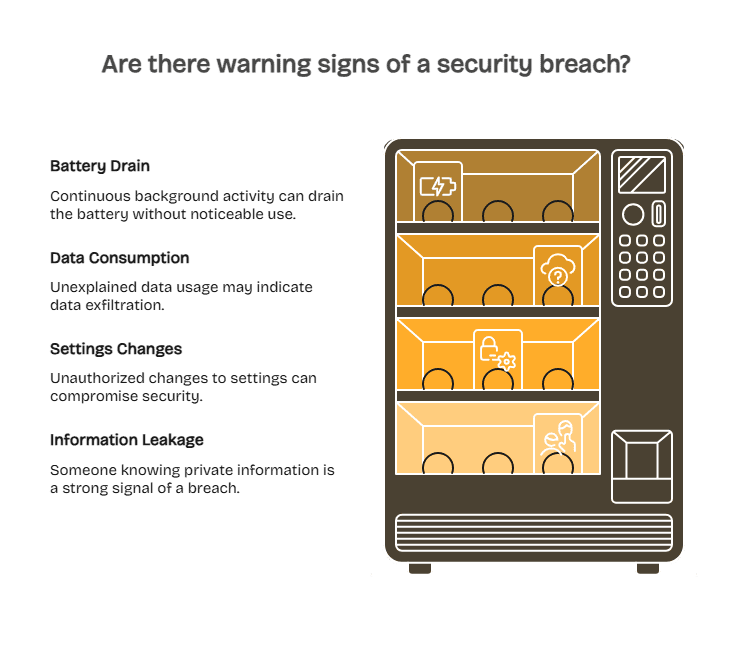
Warning signs worth taking seriously:
- Battery Drain With No Change In Use: Continuous background location and upload activity has a measurable cost.
- Unexplained Data Consumption: Screen and message exfiltration shows up on the bill before it shows up on the screen.
- Settings You Did Not Change: Device administrator permissions, disabled security software, or an unfamiliar profile installed.
- Someone Knows Things They Should Not: The most reliable signal, and the one people talk themselves out of most often
If a household is dealing with an active safety situation, physical device changes should come after a conversation with a domestic violence advocate – removing tracking software can alert the person who installed it.
Mass Surveillance Technology in Public: ALPR Networks and Facial Recognition Privacy Threats
Public-space surveillance grew faster than the rules governing it, and 2026 has become the year of the correction. Automated license plate recognition cameras now blanket ordinary neighborhoods rather than just highways; the ACLU documents roughly 80,000 to 100,000 Flock cameras across urban and rural areas in the United States, positioned on highways, inside residential areas, and outside retail businesses. These systems log make, model, color, plate, and distinguishing marks like bumper stickers into searchable databases shared across agencies.
The accountability problem is not theoretical. An Institute for Justice analysis identified at least 22 cases nationwide of officers allegedly misusing license plate reader access to monitor romantic interests, with most of those incidents occurring since 2024.
Municipalities have started to react: at least 30 localities have deactivated their Flock cameras or canceled their contracts since the start of 2025, with much of that movement concentrated in recent months. A recurring theme in those decisions is that city officials discovered after the fact that their data had been shared more widely than they understood, including with federal agencies – several California cities found their data on Flock’s national network despite state law restricting exactly that.
For a household, the practical takeaway is narrow but useful. Your vehicle’s movement history is likely retained somewhere for a set period (30 days is a common policy), it is searchable by more agencies than the one that installed the camera, and the strongest lever you have is local – attending the council meeting where the contract renewal is voted on does more than any device setting.

Privacy Threats From Smart Devices Inside the Home
The most invasive device in most homes is the one nobody suspects. A black-box audit by computer scientists at UC Davis, University College London, and Universidad Carlos III de Madrid found that smart TVs keep running automatic content recognition even when the set is used as a “dumb” external display over HDMI – so a game console, cable box, or connected laptop is fingerprinted the same as broadcast TV. The capture rates come from the manufacturers’ own documentation: LG samples frames every 10 milliseconds and transmits a fingerprint roughly every 15 seconds, while Samsung samples every 500 milliseconds and batches transmissions about once a minute.
One finding in that study is genuinely good news, and it is the reason the settings change below is worth your time: when the researchers switched off the TVs’ viewing-information consents, communication with ACR servers stopped completely.
he opt-out worked on both brands tested. Worth knowing about the limits, too – the researchers observed no ACR traffic while streaming from third-party apps like Netflix and YouTube, likely because of content-licensing agreements, so the exposure is concentrated in live TV, the manufacturer’s own free channels, and HDMI input rather than in every hour of viewing.
Regulators are now treating this as a consumer protection issue rather than an advertising footnote. The Texas attorney general filed suit in December 2025 against Samsung, LG, Sony, Hisense, and TCL over ACR data collection and the absence of meaningful consent. On February 26, 2026, Samsung became the first to settle, agreeing to stop collecting ACR data without express consent and to add clear and conspicuous disclosure and consent screens. Samsung denied wrongdoing as part of the agreement, and the cases against Sony, LG, Hisense, and TCL remain ongoing.

| Device | What It Typically Collects | Where to Change It |
| Smart TV | Screen fingerprints, app usage, ad ID | Settings → Privacy → turn off ACR (named “Viewing Information Services,” “Live Plus,” or similar by brand) |
| Phone (apps) | Precise location, ad ID, background activity | Location permissions → “While Using” only; reset advertising identifier |
| Voice assistant | Audio clips, transcripts, request history | Delete voice history; disable human review |
| Security camera | Video, motion events, cloud retention | Enable two-factor; review retention period; check third-party sharing |
| Smart doorbell | Video of public sidewalk, visitor patterns | Restrict motion zones; audit shared access |
Cameras deserve a specific note, because they are the one form of surveillance a household deploys on purpose. The security value is real – but placement determines whether a camera protects your privacy or leaks it.
We typically recommend keeping indoor cameras out of bedrooms and bathrooms entirely and angling them toward entry points rather than living space, a principle covered in more depth in our guide to indoor camera placement. Renters have an additional consideration around what is recorded in shared hallways and what a landlord may access, which shapes the recommendations in our review of security cameras suited to rental properties. And because every connected camera is also a networked computer, the hardening steps in our overview of securing IoT devices in a smart home matter as much as the mounting bracket.
Workplace Tracking and Surveillance: The Category People Underestimate
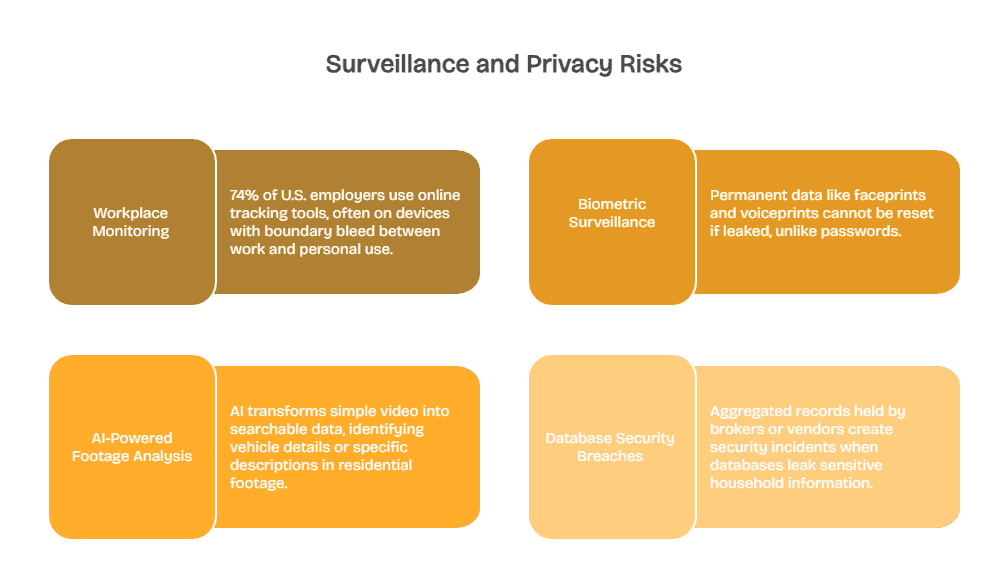
Workplace monitoring is the surveillance most households consent to without reading, and its reach expanded sharply with hybrid work. A 2025 ExpressVPN study found that 74% of surveyed U.S. employers use online tracking tools – a figure that sits above earlier Gartner estimates of 60% in 2022, which is the direction of travel worth noting even though survey methods differ enough that the numbers are not strictly comparable.
Public sentiment has not caught up with adoption. Pew Research Center found that 61% of Americans oppose employers using AI to track workers’ movements and 70% oppose AI analysis of facial expressions, with majorities also expecting collected information to be misused. The household risk here is boundary bleed: a work laptop used for personal browsing, a company phone carried on weekends, or a monitoring agent installed on a personal device under a bring-your-own-device policy. The clean fix is separation – personal traffic on personal hardware, on a network segment that does not touch work devices.
Biometric and AI-Powered Surveillance Threats: Why the Data Type Matters
Biometric surveillance risks differ from other tracking in one respect that changes everything: you cannot reset your face. A breached password takes ten minutes to replace. A leaked faceprint, fingerprint template, or voiceprint is permanent, and its value to fraudsters grows as more systems accept biometrics for authentication. Pew’s finding that 70% of Americans oppose AI analysis of facial expressions reflects a reasonable instinct about a category of data with no revocation path.
AI has also changed what surveillance can extract from footage that already exists. Systems that once logged a plate number now catalog vehicle make, model, color, decals, and physical damage, turning a plate reader into a general-purpose vehicle identifier.
The same capability applied to residential camera footage means that video which was previously only searchable by timestamp is increasingly searchable by description. This is worth knowing before enabling cloud AI features on a home camera, and worth asking about before joining any program that shares footage with third parties.
Surveillance Technology Cybersecurity Risks: When the Watchers Get Breached
Every surveillance system is also a database, and databases leak. This is the risk that turns a privacy annoyance into a security incident, because the aggregated record held by a broker, a manufacturer, or a camera vendor is more dangerous than any single data point it contains. A location broker’s files describe where thousands of families sleep. A camera vendor’s cloud holds footage of interiors. A smart TV manufacturer’s servers hold a household viewing history that maps to political leanings, health interests, and family composition.
The FTC’s orders against location brokers required the creation of sensitive location data programs and board-level review precisely because the agency treated the existence of the dataset as the hazard. For households, the operational conclusion is straightforward: the smallest reasonable retention window and the fewest reasonable sharing partners lower your risk more than any feature you can add.
That logic extends to physical preparedness too – the same households that think about data retention tend to be the ones who have thought about what happens when connected systems go dark, which is the subject of our preparation guides library and specifically our guidance on backup systems for extended grid and communications disruptions.
A Practical Household Privacy Audit
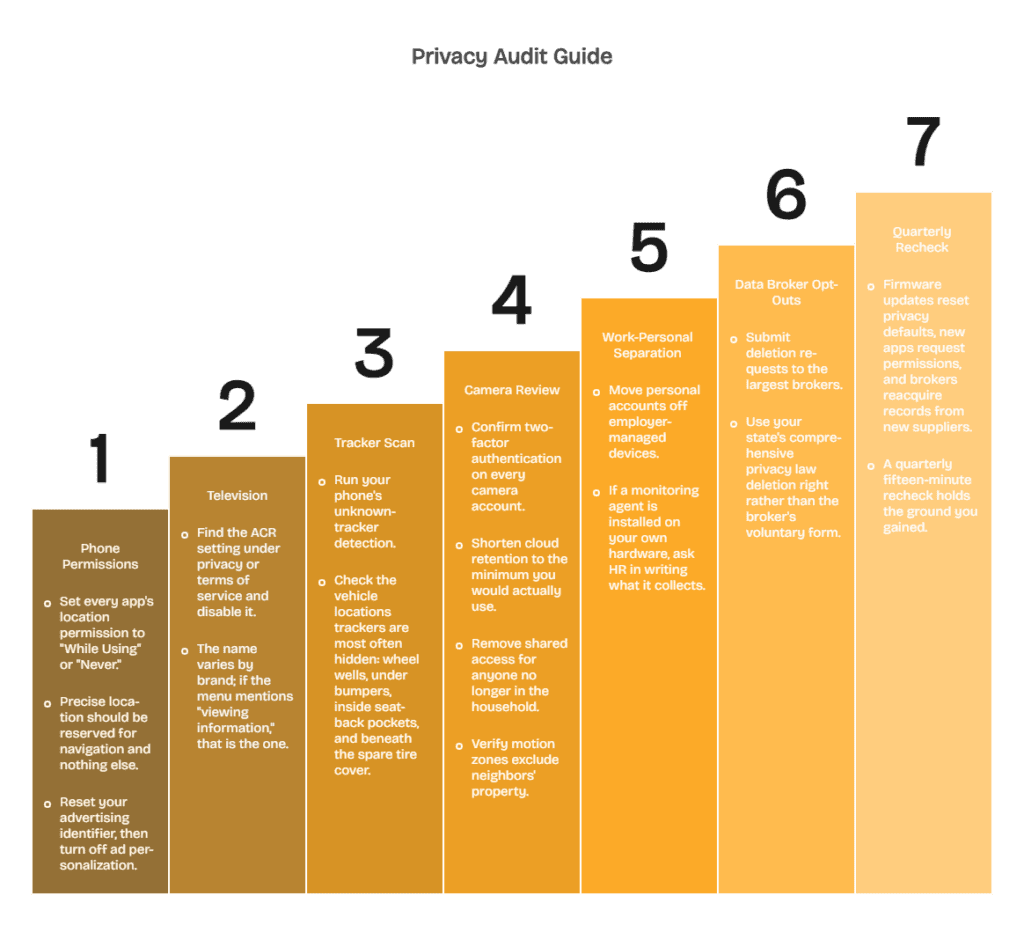
The reason most people stay exposed is not indifference – it is that generic privacy advice never says what to do first. A focused audit takes about ninety minutes and addresses the majority of realistic exposure for a typical household.
- Phone Permissions (20 Minutes): Set every app’s location permission to “While Using” or “Never.” Precise location should be reserved for navigation and nothing else. Reset your advertising identifier, then turn off ad personalization.
- Television (10 Minutes): Find the ACR setting under privacy or terms of service and disable it. The name varies by brand; if the menu mentions “viewing information,” that is the one.
- Tracker Scan (10 Minutes): Run your phone’s unknown-tracker detection, and check the vehicle locations trackers are most often hidden: wheel wells, under bumpers, inside seat-back pockets, and beneath the spare tire cover.
- Camera Review (20 Minutes): Confirm two-factor authentication on every camera account, shorten cloud retention to the minimum you would actually use, remove shared access for anyone no longer in the household, and verify motion zones exclude neighbors’ property.
- Work-Personal Separation (15 Minutes): Move personal accounts off employer-managed devices. If a monitoring agent is installed on your own hardware, ask HR in writing what it collects.
- Data Broker Opt-Outs (Ongoing): Submit deletion requests to the largest brokers, and if your state has a comprehensive privacy law, use its deletion right rather than the broker’s voluntary form.
None of this is a one-time task. Firmware updates reset privacy defaults, new apps request permissions, and brokers reacquire records from new suppliers. A quarterly fifteen-minute recheck holds the ground you gained.
Conclusion: Reduce the Record, Not Just the Worry
Commercial tracking and surveillance technology threats in 2026 are less about any single villain and more about default settings that nobody chose. Location brokers built businesses on consent nobody gave, televisions shipped with fingerprinting enabled, item trackers designed for luggage became the cheapest stalking tool available, and monitoring software followed people from the office into their homes.
Regulators are catching up in pieces – the FTC on location, Texas on smart TVs, states on trackers, cities on plate readers – but enforcement is slow and partial, and it works retroactively on data that has already been collected.
The households that end up in a better position are not the ones that bought the most privacy products. They are the ones that spent an afternoon reducing how much of their daily life gets recorded in the first place, then checked again a few months later. That is a habit, not a purchase, and it pairs naturally with the physical side of protecting a home.
Ready to tighten up both sides of your home’s security? Batten Home Security’s research library and buying guides break down connected devices by what they actually collect and how to configure them safely, and our scenario-based preparation guides cover what to do when the systems you depend on stop working. Straightforward guidance, no hype, from a team that has helped thousands of families make these decisions.
Frequently Asked Questions About Tracking and Surveillance Technology Threats
Can a VPN Stop Tracking and Surveillance Technology Threats?
A VPN hides your IP address and encrypts traffic in transit, which limits network-level observation, but it does nothing about app permissions, advertising identifiers, smart TV fingerprinting, or Bluetooth trackers. Location data brokers typically obtain data from inside apps you have authorized, not from your network path. Treat a VPN as one layer among several, not a solution to surveillance technology privacy concerns.
How Do I Tell the Difference Between Legitimate Government Surveillance Technology and Commercial Tracking?
The practical distinction is who holds the data and under what authority. Government surveillance generally requires legal process and is subject to public records law, while commercial tracking operates on terms-of-service consent with far less oversight – which is why agencies increasingly buy commercial data rather than seek warrants. Recent court decisions have held that plate reader images stored by a private vendor can still qualify as public records.
Are Home Security Cameras Themselves a Surveillance Risk?
They can be, depending on placement, account security, and cloud retention settings. A camera aimed at an entry door with two-factor authentication and short retention is low risk; an unsecured indoor camera streaming a living room to a default-password account is a serious one. Our walkthrough of indoor camera placement covers the placement rules that keep a camera useful without turning it into an exposure.
Does Turning Off Location Services Actually Prevent Location Tracking Privacy Concerns?
It substantially reduces precise tracking but does not eliminate location inference. Your IP address, Wi-Fi network names, cell tower connections, and even photo metadata can indicate approximate location. Setting apps to “While Using” and denying precise location to anything that is not a maps or delivery app removes the highest-resolution data, which is the data brokers value most.
What Should Renters Do Differently About Invasive Surveillance Technology?
Renters face two extra questions: what the landlord records in shared spaces, and what a smart lock or camera provided by the building can access. Ask what footage is retained and for how long, and prefer devices you control and can take with you. Our comparison of cameras suited to rental properties covers the no-drilling, no-contract options that make this simpler.
Is There a Cost to Reducing Online Tracking Security Risks?
The audit itself is free – permissions, settings, and opt-outs cost nothing but time. Paid data removal services handle broker opt-outs on an ongoing basis, which is a convenience purchase rather than a capability you lack. If a state comprehensive privacy law applies to you, its deletion right is more enforceable than a broker’s voluntary form and also free to use.
Do Bluetooth Tracker Alerts Work on Android and iPhone?
Both platforms now support unwanted tracker detection under an industry specification, so an iPhone will alert on many Android-ecosystem tags and vice versa. Coverage is not universal across every brand of tag, and alerts can take time to appear if the tracker is stationary near you. Manual scans and physical vehicle checks remain worth doing when there is a specific concern.
Sources
- “FTC finalizes order banning Mobilewalla from selling sensitive location data,” 2025, Federal Trade Commission, https://www.ftc.gov/news-events/news/press-releases/2025/01/ftc-finalizes-order-banning-mobilewalla-selling-sensitive-location-data
- “FTC order prohibits data broker X-Mode Social and Outlogic from selling sensitive location data,” 2024, Federal Trade Commission, https://www.ftc.gov/news-events/news/press-releases/2024/01/ftc-order-prohibits-data-broker-x-mode-social-outlogic-selling-sensitive-location-data
- “Views of data privacy risks, personal data and digital privacy laws in America,” 2023, Pew Research Center, https://www.pewresearch.org/internet/2023/10/18/views-of-data-privacy-risks-personal-data-and-digital-privacy-laws/
- “Americans’ views on use of AI to monitor and evaluate workers,” 2023, Pew Research Center, https://www.pewresearch.org/internet/2023/04/20/americans-views-on-use-of-ai-to-monitor-and-evaluate-workers/
- “Kaspersky: half of adults have experienced tech-enabled abuse, but most don’t recognize it,” 2026, Kaspersky, https://www.kaspersky.com/about/press-releases/kaspersky-half-of-adults-have-experienced-tech-enabled-abuse-but-most-dont-recognize-it
- “Police records show women are being stalked with Apple AirTags across the country,” 2022, Vice, https://www.vice.com/en/article/apple-airtags-police-reports-stalking-harassment/
- “Florida law cracks down on high-tech tracking devices used in crimes,” 2025, CBS12 News, https://cbs12.com/news/crime/florida-law-cracks-down-on-high-tech-tracking-devices-used-in-crimes-apple-airtag-stalking-hidden-car-oct-6-2025
- “Fight creepy ALPR cameras,” n.d., American Civil Liberties Union, https://www.aclu.org/campaigns-initiatives/get-the-flock-out
- “The backlash against Flock cameras is spreading,” 2026, Malwarebytes Labs, https://www.malwarebytes.com/blog/news/2026/07/the-backlash-against-flock-cameras-is-spreading
- “Why some cities are ditching their Flock license plate readers,” 2026, NPR, https://www.npr.org/2026/02/17/nx-s1-5612825/flock-contracts-canceled-immigration-survillance-concerns
- “Automated content recognition technology takes privacy enforcement spotlight,” 2026, International Association of Privacy Professionals, https://iapp.org/news/a/automated-content-recognition-technology-takes-privacy-enforcement-spotlight
- “Attorney General Paxton secures major agreement with Samsung to ensure that Texans are protected from smart TVs collecting their data without their knowledge,” 2026, Office of the Attorney General of Texas, https://www.texasattorneygeneral.gov/news/releases/attorney-general-paxton-secures-major-agreement-samsung-ensure-texans-are-protected-smart-tvs
- “Watching TV with the second-party: a first look at automatic content recognition tracking in smart TVs,” 2024, Proceedings of the 2024 ACM Internet Measurement Conference, https://dl.acm.org/doi/10.1145/3646547.3689013
- “Bossware rises as employers keep closer tabs on remote staff,” 2025, The Register, https://www.theregister.com/2025/11/23/bossware_monitor_remote_employees/